
Hood County Jail Release Paths
Hood County Jail is the Sheriff’s primary county detention facility. A person may leave the building after posting bond, after a judge orders release, when a county sentence is complete, or when jail credit satisfies the term. Those are not the only exits. Hood may transfer a person to the Texas Department of Criminal Justice, another county acting on a warrant, a federal authority, ICE, a hospital, or a contract jail. A transfer ends physical presence at Hood County Jail but does not end custody.
The first useful question is whether the person remains physically at the jail. The second is whether the person entered the community. Call the booking desk for the first point-in-time check. For the second, obtain the release or transfer code, compare it with the criminal case, and follow any receiving agency. A bond approval or court order supplies legal authority, but processing and unresolved holds can delay the actual door time.
| Departure | What it means | Best confirmation |
|---|---|---|
| Bond or court order | Possible community release after processing | Jail release entry and court docket |
| Sentence complete | County custody term calculated as satisfied | Judgment, jail credit, and release sheet |
| TDCJ transfer | Continued state custody | TDCJ offender record |
| Other hold | Another authority takes custody | Receiving agency plus Hood transfer record |
Confirm Hood Jail Release Records
The Sheriff’s View Bonds report displays name, race, sex, and book date. Opening a row can show a photograph, local person number, physical descriptors, arrest and booking details, charges, warrant or on-view status, offense class, and required bond. It has no release date, release time, release reason, destination, or 24-hour release filter. Presence supports a current listing at the moment observed. Absence only creates a reason to check further.
Use a short sequence that preserves the distinction between current display and completed release:
- Search the live bond report and record the observation time.
- Call Hood County Jail at 817-579-3333 with the full name, date of birth, and booking number if known.
- Ask whether the public status is still in Hood custody, community release, or transfer.
- Check the felony District Clerk or misdemeanor County Clerk docket for the legal order.
- Request the existing booking and release sheet when written proof is needed.
A name disappearing from View Bonds does not distinguish release, transfer, correction, or system lag.
Request Hood Jail Release Details
The Sheriff Records Division request page accepts a focused request for existing records. Identify the person, date of birth, booking or report number if known, event date and location, precise date range, and preferred delivery method. Ask for the booking/release sheet, custody event history, actual release date and time, release type or disposition, releasing authority, and receiving agency or destination if public. The agency need not create a narrative or answer why a person was released.
Requests may be emailed to pialaw@hoodcounty.texas.gov, mailed to Hood County Sheriff’s Office, Attn: Records Division, 400 Deputy Larry Miller Drive, Granbury, TX 76048, delivered there in person, or faxed to 817-573-7372. The Sheriff warns that email or mail must reach its designated Records Division channel. Texas Government Code Chapter 552 governs the request, while statutory exceptions may require redaction or withholding.
400 Deputy Larry Miller Drive
Granbury, TX 76048
Booking: 817-579-3333, available 24/7
Records email: pialaw@hoodcounty.texas.gov
Records fax: 817-573-7372
The Sheriff does not hold every related record. Granbury Police keeps its police reports, and court clerks keep dispositions. Route each request to the office that created the record.
Hood Jail Courts and IVSS
A court record can explain the legal authority behind an exit. Felony cases belong with the 355th District Clerk. Misdemeanor cases use the County Clerk court search. Useful entries include the cause number, bond order, dismissal, judgment, sentence, jail credit, warrant, revocation, and later orders. Yet a docket entry may not state when jail staff completed physical release.
Texas IVSS-Counties can add a custody-change event or notification. It replaced legacy county VINE participation in Texas. An IVSS event is corroboration, not the Sheriff’s official release sheet, and a transfer notice may show that county custody ended while confinement continued elsewhere. For documentary proof, the Hood release entry remains stronger.
The most reliable finding pairs sources. A release sheet with date, time, and release or transfer code directly reflects county custody. A contemporaneous booking-desk statement is a strong point-in-time check. Court action supports authority. IVSS supports the event. A live roster absence remains the weakest of those official clues.
Hood Contract Release Returns
Hood County can place prisoners in another county’s beds under an interlocal agreement. A documented 2025 agreement with Burnet County shows why the release chain matters. Under that agreement, Hood prisoners bond in Hood County and are transported back to Hood’s facility for release. Departure from the host jail is therefore transport into Hood custody, not release into the community.
For a contract placement, reconcile three records: Hood’s originating booking and hold, the host jail’s movement entry, and Hood’s final release event. A bond order may come before the return trip. Contacting only the host jail can leave the process half documented. The dedicated Hood contract-bed pathway explains this local return sequence in more detail.
Similar caution applies to TDCJ, ICE, and federal pickups. Each receiving system uses its own locator and record terms. Never convert “released to agency” into “released to the public.”
Hood Jail History and Records
The Sheriff’s jail page identifies the current facility and its official contact details.
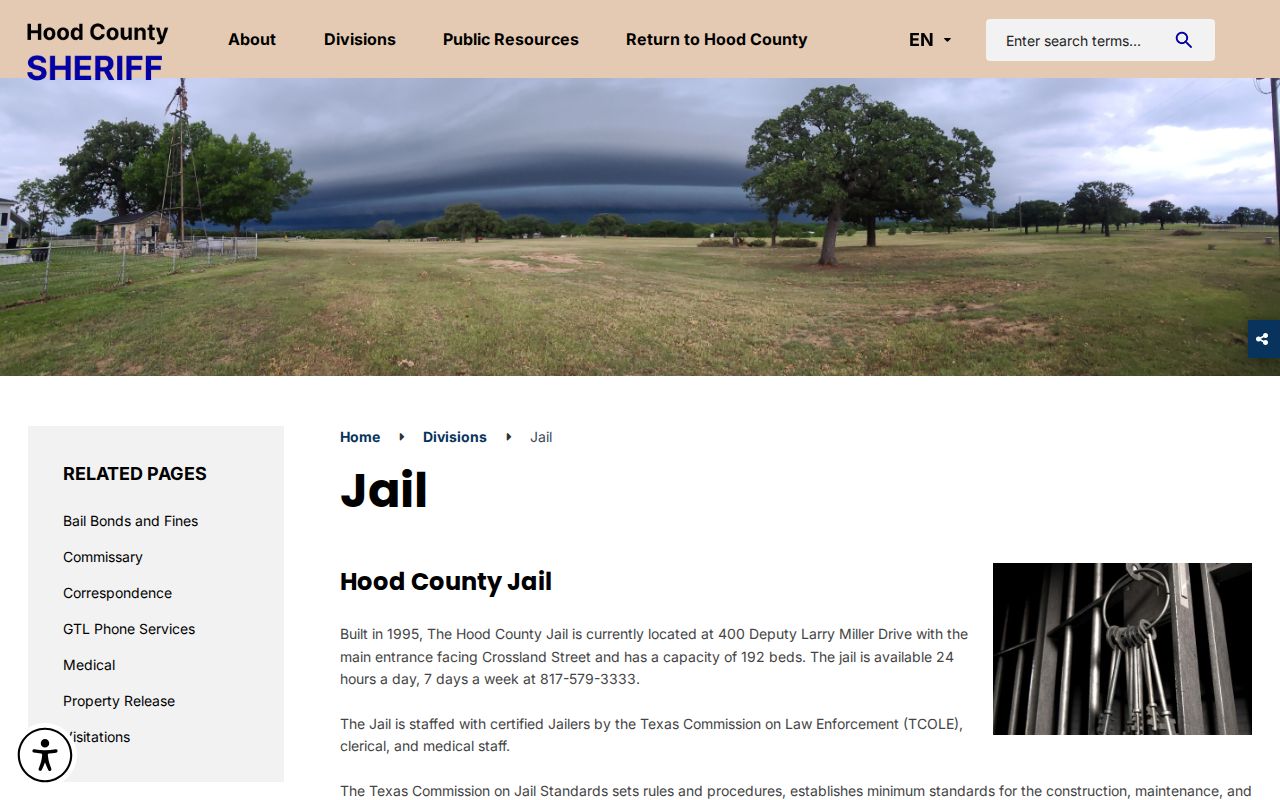
The official page, shown above, is the correct starting point for modern Hood County Jail custody and release questions. The Sheriff says the current 192-bed jail was built in 1995 and is staffed by certified jailers, clerical staff, and medical personnel. It is regulated and inspected under Texas Commission on Jail Standards requirements.
Hood County’s earlier jail at 208 N. Crockett Street operated from 1886 through 1978. It is now the Old Jail Museum. The museum is a source for local history, not a present custody office. It cannot verify a modern release, locate a current booking, or supply the Sheriff’s booking and release sheet.
This distinction prevents a local-search trap. Historic building pages may rank for “Hood County jail,” yet only the operating Sheriff channels can establish a current custody movement.
Hood Jail Property Release
The Sheriff publishes a separate property-release procedure. An inmate may authorize family or friends to collect property by completing a form. The collector must show government identification and sign. Pickup is unavailable during meals, shift changes, or visitation, so the Sheriff advises calling booking before traveling.
That procedure concerns an inmate-authorized third-party pickup. It does not establish what property staff automatically return when the person is released, nor does it prove that a custody release occurred. Keep the property form and the booking/release record as separate documents. For the broader person search and release-record field inventory, use the Hood County released inmates search.
When timing matters, call first. The booking desk can confirm whether the property process is available and whether the person remains in Hood custody.
Public Record Search
Sponsored Results